Digitally Printing Products from Blank to Branded in Seconds

The Tesseract, Norwalt’s fast, flexible direct-to-object printing machine powered by XPlanar ushers in the “factory of the future”
In a world of mass customization, the winning line is the one that can adapt on demand. In today’s market, labels are changing faster than ever – artwork, materials, and SKUs shifting by the week – requiring a factory that can change just as rapidly. The “factory of the future” isn’t a place, but a platform that is ready to reconfigure at the speed of the market.
For five decades, Norwalt Automation Group has engineered its success through custom machine automation. The third-generation, family‑owned business with facilities in Randolph, New Jersey and Tampa, Florida serves several industries, including digital printing, packaging, pharmaceuticals, and food and beverage. The company’s core strength lies in solving complex, custom automation problems for large CPG (consumer packaged goods) customers, often Fortune 50 companies, where tailored machinery and powerful engineering create a competitive advantage.
Over the last several years, Norwalt sharpened its focus on delivering the factory of the future to its clients with production systems that can run a wide variety of products on a single line, minimize changeover time, and give CPG manufacturers the power to respond quickly to market trends with new product variations. “We had a big push towards flexible machinery so customers could go about different business concepts like customization with print, or better demand forecasting,” said Norwalt Technical Sales Director Kyle Seitel. That strategic direction helped tackle growing market pressures, as major brands sought faster regional product launches, seasonal SKUs, and reduced inventory risk. Setting the stage for a new product initiative built around direct‑to‑object digital printing with a modular maglev intelligent transport platform and a rotary machine, all using Beckhoff automation technology.

A completely new path to printing progress
Commercial label printing in the packaging industry is often a time-consuming and costly process that can also have a significant environmental impact. Traditional printing methods with plastic and paper labels frequently involve lengthy setup times, frequent manual interventions, and much larger amounts of material waste due to misprints or inefficient changeovers. Brands that wanted to experiment with limited editions, regional designs, or rapid promotional runs were typically forced to either outsource small runs to contract packaging companies or accept high sunk costs and long waits.
These factors drive up operational costs and slow down production lines, putting pressure on manufacturers to find faster, more reliable solutions. As these pressures rose, many brands sought a better path - one machine that could handle multiple products and packaging types without the costs associated with pre‑printed labels, which is why more CPG companies are turning to Norwalt.
Norwalt saw the need to completely rethink how label-printing machines are designed – moving toward solutions that accelerate printing, minimize waste, and lower cost. The resulting approach is direct-to-object printing. “A lot of time, what happens in the CPG market is costs start shooting through the roof because you’re ordering large reels of labels, you have to hold them in an air-conditioned unit, and it takes up a lot of space that could be dedicated to other manufacturing,” said Seitel. “When you move to direct-to-object printing, you’re basically replacing label reels with ink. A bottle of ink goes a long way and doesn’t need to be put in a special room. Lowering costs.”
Norwalt’s direct‑to‑object printing technology offers expanded flexibility to print labels on diverse product and package geometries with exceptional precision, repeatable positioning, and sub‑millisecond synchronization between part movement and printhead timing. Many direct‑to‑object systems are limited to a single geometry and cannot handle tapered, irregular, or complex shapes without extensive mechanical fixturing. Norwalt’s goal was to support a wide variety of geometries in one flexible machine, allow rapid software‑driven changeovers, and scale throughput by adding modules as needed in the field. Achieving this required an automation and motion control architecture that coordinated multiple axes with deterministic timing that simplified commissioning and diagnostics, and let engineers develop reusable, modular software instead of relying on fixed Ladder Logic and fragile mechanical setups.
Opening up six degrees of motion in printing
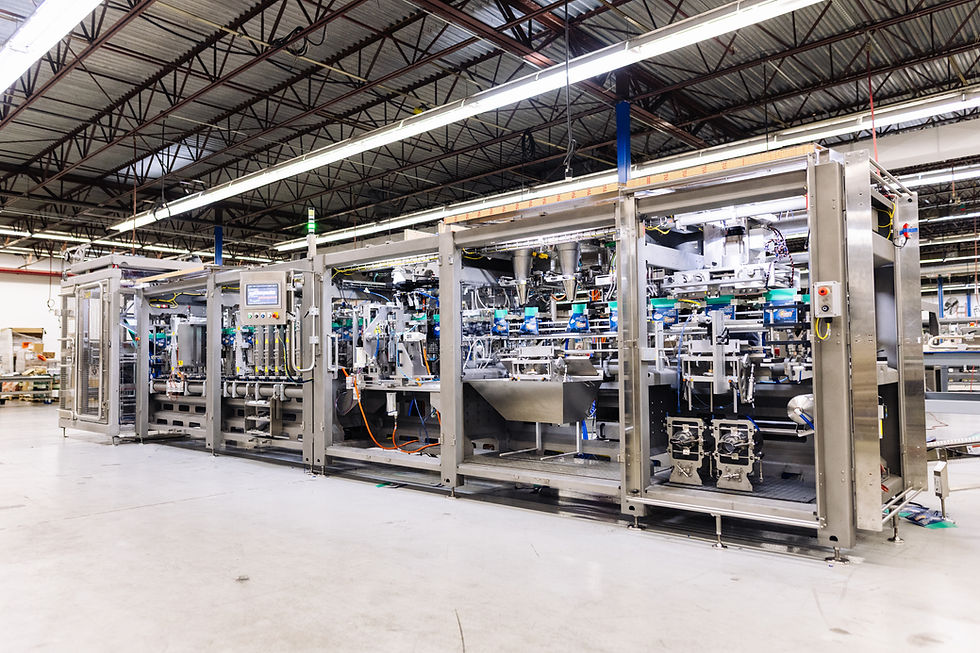
The direct‑to‑object printing solution that Norwalt developed is now known as the Tesseract, a modular machine built around Beckhoff's XPlanar magnetic levitation technology and a PC‑based automation backbone. In geometry, a tesseract refers to a hypercube that extends a 2D square and a 3D cube into four dimensions and exhibits complex properties, especially when rotated. Norwalt’s equally advanced Tesseract began as a napkin sketch concept on a bar napkin after viewing a demo of the mechatronic motion capabilities of the XPlanar system: Norwalt engineers imagined using the magnetic movers to dynamically position parts with six degrees of freedom so that a single print engine could cover many more geometries. They validated the idea incrementally by testing a small three‑by‑three array of XPlanar tiles with a single printhead and then scaling up by adding tiles and additional printheads as needed. This modular approach allowed Norwalt to quickly grow capacity in the field with minimal rework. “That’s the real beauty of XPlanar - as we run out of room, we can just keep adding tiles,” said Seitel.
XPlanar flying movers and TwinCAT running on a CX2062 Embedded PC provide the flexible, software‑driven, adaptive part handling Norwalt required. Movers can rotate parts 360°, translate them in X and Y coordinates, and even adjust Z height up to 5 mm, so complex geometries are moved optimally around the printheads for high-quality labeling. With six degrees of freedom in motion, XPlanar allows Norwalt to ensure consistent printing down to the sub-millimeter. The containers are loaded and unloaded onto the levitating XPlanar movers by a robot arm.
Motion profiles are software controlled, so changing the path from circular to linear or adjusting dwell points is a button‑press operation via the HMI rather than an exhaustive mechanical changeover. “We don’t have to modify any of the Tesseract’s mechanical components. We can do everything on the fly with just the press of a button,” said Norwalt Controls Engineer Darshan Nayee.
For additional motion control, DIN rail mounted ELM7212 servo terminals and AM8000 series servomotors controlled printhead positioning and any linear axes that required high precision; these ultra-compact drives were networked via EtherCAT to ensure low‑latency triggering and smooth overlay of multiple ink colors. EtherCAT provided deterministic, high‑speed communication across the Tesseract’s range of distributed I/O modules, enabling extremely tight system-wide synchronization. Instead of spending hours assigning IP addresses and tracing wiring errors, with EtherCAT’s diagnostic capabilities, engineers can scan the EtherCAT network and quickly identify all connected devices and find the exact location of cabling problems, reducing commissioning and debugging time from days to minutes in many cases. Machine safety is also integrated via TwinSAFE I/O terminals and Safety over EtherCAT (FSoE).
The TwinCAT HMI software, which includes a PackML state machine, is displayed on CP22xx multi-touch Control Panels and CP3xxx series Panel PCs. TwinCAT automation software became the unified development environment for XPlanar, PLC, all motion control, HMI, safety, and higher‑level PC tasks. Norwalt’s engineers leveraged TwinCAT’s structured text and object‑oriented programming (OOP) capabilities to build modular, reusable function blocks, properties, and methods, and standardized motion profiles they could apply across machines. The text‑based workflow also allowed Norwalt to adopt standard software version control practices - branching, commits, and merges - which speeds up development and makes rollbacks and audits straightforward.
Norwalt’s software engineering – including use of object‑oriented programming, function blocks, version control, and modular software libraries - cut programming and merge times substantially; what once required hours of careful manual work is now achievable in minutes through standard software workflows. That productivity translates into faster machine iterations, quicker fixes in the field, and more predictable delivery schedules.
Equally important to Norwalt was the human and support side of the solution: by working closely with Beckhoff USA’s Special Projects Team (SPT) and technical support, Norwalt’s controls engineers climbed the learning curve quickly and received practical help for complex integrations. “I couldn’t have asked for better people to get me to a point where I can take projects and run them on my own,” said Michael Forte, Controls Engineer at Norwalt. The collaboration between Norwalt and the SPT reduced risk and accelerated timelines while building Norwalt’s internal expertise and standardized development patterns.
The proof is in the print
The Tesseract program delivered multiple successful outcomes that addressed the commercial and technical challenges Norwalt set out to solve. The most visible impact is operational flexibility: direct‑to‑object printing removes the need for large reels of labels and their associated waste, slashes holding costs, and lets companies run short, customized, or regional SKUs on demand. Marketing teams can introduce test designs or launch event‑specific packaging with minimal sunk cost and no long lead times. The machine’s modularity enabled by XPlanar means customers can buy a baseline system and expand capacity by adding tiles or print modules when volume demands increase.
Norwalt also achieved large reductions in mechanical complexity and improved maintainability. The maglev mover system replaced many traditional mechanical components and gearboxes. “Mechanically, it reduces the cost of a machine by 30% to 40%, saving hundreds of thousands of dollars,” said Norwalt’s Executive Business Director, Keith Harman. The smaller mechanical footprint also reduced machine size, which is significant for customers where factory floor space is limited and costly.
Fewer mechanical parts also mean fewer failures. “And for any errors we do get, 95% of all fixes can be handled remotely because there’s no mechanical failure to correct,” said Harman. With a large portion of service requirements that can be resolved remotely through rapid software changes, Norwalt’s travel and on‑site support time is reduced significantly.

Product quality and print performance improved as well. Precise control and tightly synchronized EtherCAT communications allowed multiple color passes with the registration accuracy required for high‑quality results. The team highlighted features like the ability to have movers go up and down on the Z axis to create a two‑height white undercoat, boosting coverage and consistency without mechanical adjustments. Together, levitating XPlanar movers, compact servo systems, and software‑driven motion profiles made it possible to print on a wider range of geometries than conventional single‑station systems, expanding the addressable market for direct‑to‑object printing solutions.
Norwalt’s Tesseract effort translated an ingenious sketch and a strategic push towards flexible automation into a working, scalable direct‑to‑object printing platform that’s ready for field deployment in CPG applications. By minimizing complexity and migrating from traditional mechanics to XPlanar and a PC-based control approach, Norwalt created a machine that reduces inventory burdens, enables fast market‑driven customization, simplifies commissioning and service, and expands the variety of geometries that can be printed on a single line. The result is a machine and process that fit the company’s long‑term goal of delivering the factory of the future to CPG and pharmaceutical companies through adaptable, future‑ready automation and mechatronics.
Ready to say ‘goodbye’ to traditional labels and ‘hello’ to the future of labeling with direct-to-object printing? Contact your local Beckhoff sales engineer today.

Ella Anderson is the Marketing and Communications Intern at Beckhoff Automation LLC

Comments